Are Expensive Running Shoes Worth the Extra Cash? Here's What Our Lab Testing Reveals.
The Outside Lab allows us to objectively measure how shoes compare and perform over time.(Photo: Adam Trenkamp)
Running shoes, unlike a lot of other gear items, aren’t a “buy it for life” proposition. No matter how carefully you clean and store your kicks, at some point, the tread wears down, the foam cushioning fails to bounce back, and the upper tears—and that “some point” may be as often as four to six months,depending on your mileage.
But can buying a more expensive pair of running shoes slow down that purchase-use-repurchase cycle? And, are more expensive running shoes just plain better to run in? Those are the questions Maggie Slepian asked when she decided totest $50 Amazon running shoesagainst familiar name-brand options, like the $155Hoka Clifton 10and the $240Saucony Endorphin Pro 4(now updated to the Endorphin Pro 5).
Her conclusion? Despite costing less than half as much as the other models,Amazon’s Nortiv 8 Allswifit ActiveAiry running shoesfelt in the same league as more premium shoes. While the Nortiv 8 shoes were a little chunkier and simpler in terms of construction, the actual foam seemed just as bouncy as the other shoes Maggie tested. For beginners, casual runners, or anyone looking to save a buck, Maggie wrote, budget running shoes are probably fine if they fit your foot’s needs.
That wasn’t enough for us, though. We called in Adam Trenkamp,Outside’s Lab Test Editor and Engineer, to do more testing in the Outside Lab at CU Denver. That’s actually part of our process for ourgear guides—field- and lab-testing, so you can see how kits perform in real-world situations and in controlled environments that accelerate wear and tear.
Adam put fresh pairs of the running shoes Maggie field-tested through four of our typical lab tests: abrasion, breathability, foam compression, and run durability. Did his results mirror Maggie’s? I’ll toss to the Lab expert himself to explain.
How We Test Running Shoes in the Outside Lab
Abrasion and Breathability
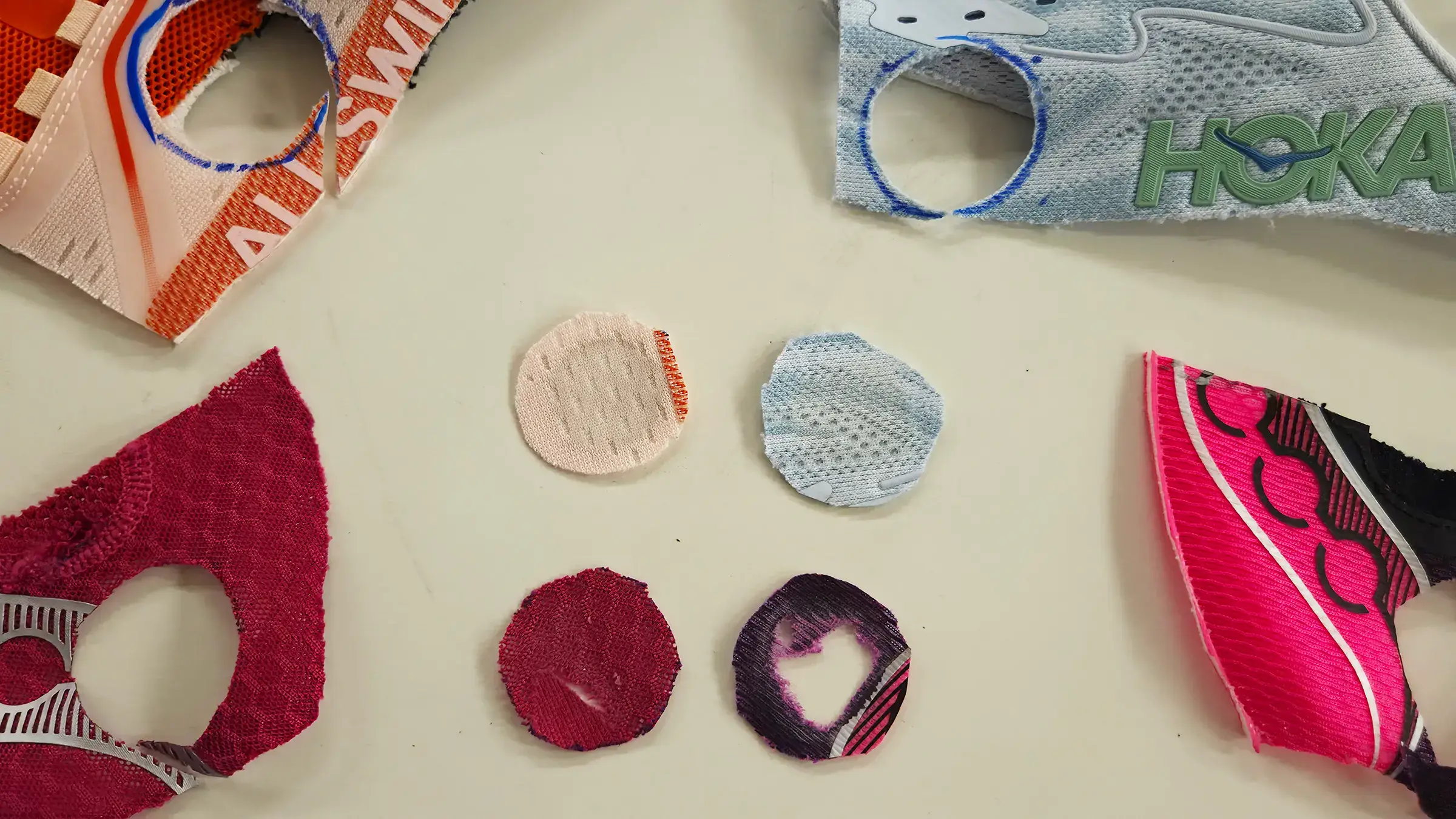
To test abrasion durability, we use a James Heal AquAbrasion machine, which rubs two materials together to analyze wear. For running shoe uppers, we use two different test scenarios to evaluate normal and extreme, accelerated wear. One test uses a wool fabric as the abradent (the material rubbed against the test sample) to mimic normal wear during use. A second test uses a more aggressive material to accelerate wear and really evaluate the toughness of the shoes.
Breathability measures how well moisture vapor—sweat—transfers through a material. To test breathability, we seal a section of the shoe’s toe box over a jar of water which is heated to a consistent 102 degrees F, simulating body temperature during a sweaty workout to create similar moisture vapor. Since the Outside Lab is in Denver, the generally dry air (approximately 25-35% relative humidity) helps draw out moisture during testing. We track how much weight the sample assembly loses over time due to evaporation; more weight loss equals better breathability. Shoes are scored 1 to 5, least to most breathable.
One note: Our test only accounts for the upper material and doesn’t consider the running motion, which may help force out additional sweat vapor. Though our test is static, it allows us to accurately compare different materials and constructions.
Lab Results
For abrasion, tested samples are graded on a visual scale of 1 to 5, worst to best. Top performers with very little or no change to the material scored a 5, while samples that ripped or completely changed in appearance and feel received a score of 1. The Allswifit Active Airy shoes earned the highest possible score on upper abrasion, while the way-more-expensiveSaucony shoessurprised us with middling-to-low scores—despite costing about four times as much. This is due to the thinner materials used in the upper of the premium Saucony Endorphin Pro series to increase performance in other areas. If you find yourself stepping off the pavement and onto a light trail occasionally where you might catch a snag, or mysteriously rubbing holes in the upper of your shoe (particularly where the forefoot flexes), more expensive race-focused runners might let you down.
If sweaty feet really ruin your running vibe, however, it might be worth it to splurge on the fancy shoes. The Lab found that the more expensive a shoe was, the higher its breathability scores. Uppers on more premium models tend to be made of thinner material with an airy weave, making it easier for moisture to escape. This construction, however, can lead to reduced durabilty—see above.
Foam Compression
In the Outside Lab, we measure a running shoe’s midsole foam properties by using our universal test machine to compress the heel and forefoot impact zones 26 times each to a set depth, recording the force required to press it down throughout the cycle. We analyze the graph of the final compression cycle to see where the foam stops sinking in and starts to bounce back. Specifically, we evaluate the slope of the curve in the graph and recorded force during the normal running compression range—where the foam sinks in and bounces back during normal running stride—and near its maximum effective point, when the foam begins to stop compressing and becomes noticeably harder.
We combine these measurements into a lab score that reflects how firm the sole feels under the same loading conditions. Results are graded on a 1 to 5 scale, with 1 being stiff and 5 being soft.
Here, the budget running shoe was a clear outlier. The Allswifit ActiveAiry shoes scored a 1, indicating more stiffness, while theHoka Clifton 10andSaucony shoesscored 4 and 3, respectively. When it comes to squish, the budget kicks can’t compete with the plush and responsive engineered foams found in pricier models. But stiffness isn’t always a bad thing. Comfort is subjective and comes down to the feel you prefer underfoot. The test results give a good idea of how each shoe will feel out of the box to help you compare and find the right feel.
Run Durability
We test the durability of the midsole and outsole of shoes using the Heeluxe Time Machine to replicate the impact of human running. The machine uses flexible footforms with positionable ankles along with tensioned springs to simulate the stride of a 180-pound person cruising at an eight-minute-mile pace. Based on previous studies, we know how many “steps” per shoe equate to a mile. We use these numbers to run each shoe for a total of 125 miles, with stops at 10 and 25 miles to take measurements, giving us two ways to evaluate durability: midsole foam breakdown and outsole tread wear.
• We measure foam height in the heel and forefoot before the start and at the end of each test cycle to chart how it wears over time. As foam breaks down, it loses bounce and cushioning—basically, your shoe gets tired, which can more easily pass stress into your feet and joints. • We also record the weight of each shoe at the beginning of the test and at each mileage interval to see how much material was “lost” during testing. We use this data to calculate how many miles a shoe’s outsole will last. At the end of the test, we take a hard, close look at the outsole wear patterns to assess its breakdown.
Shoes are scored on a scale of 1 to 5, worst to best for wear and durability. Each shoe is evaluated for performance at the 25 mile and 125 mile distances. This provides data for a single marathon distance (almost), and a longer distance for weeks of training. Gauging the breakdown over time allows us to predict the end of life of each shoe.
At lower mileage, the shoes we tested had similar durability scores; the budget, mid-priced, and premium shoes had the exact same overall score after “running” for 25 miles (although they showed different levels of durability within the midsole foam and outsole tread).
It’s at higher mileages that premium shoes start to show their worth. While the budget Nortiv 8s and the mid-pricedHokashad the same overall score after 125 miles, theSaucony modelswe tested scored higher overall despite their ultralight supershoe designs. Worth noting: At both distances, the Nortiv 8 shoes had the lowest outsole durability scores with excessive rubber shedding, suggesting they may break down faster than more expensive pairs. The rubber outsole provides grip and also protects the foam in key impact areas.
So, Are More Expensive Running Shoes Better, According to Lab Testing?
It all depends on what you’re looking for. If you value breathability, rebound, and durability, go ahead and spend out on your shoes—especially if you run frequently and see yourself using these shoes for several hundred miles before replacing them. Just know that the upper material may be a little more delicate than hardier, cheaper options.
But if you’re a more low-key runner, take comfort in the fact that cheap running shoes are comparable to pricey models in a lot of ways. The major differences are found in foam performance and durability over time.
Remember, running shoes are highly personal, and our lab testing is just one aspect to consider when finding thebest running shoefor you. The more we test, the more we know—and the farther your running shoes can take you.
Shop the Article
Budget Road Running Shoes:Nortiv 8 Allswifit ActiveAiry,$51 at Amazon
Mid-Priced Road Running Shoes: Hoka Clifton 10, $125 (Shop Men’s|Shop Women’s)
Premium Road Running Shoes:Saucony Endorphin Speed Pro, $191 (Shop Women’s|Shop Men’s)
READER NOTES